This group of farm buildings is located in Grady, Arkansas, on the flat delta land near route 65.
If you'd like to purchase this 11" x 15" original watercolor painting for $200 including shipping within the United States, you can do it securely on my website www.jimoberst.com (click on the image). There are additional paintings for sale there, and my smaller paintings are available on my other website www.weeklywatercolor.com. Add a unique original painting to your collection!
To join my fine art e-newsletter mailing list click Here.
Friday, May 3, 2013
Arkansas Delta Farm - Original Watercolor Painting
Labels:
new paintings
Sunday, April 21, 2013
Artist Tip #14 - Principles of Design (Part 4)
This is the fourth and last artist tip on the seven Principles of Design:
- Contrast
- Gradation
- Repetition with Variation
- Harmony
- Balance
- Dominance
- Unity
We've covered the first five, and in this post will cover the final two principles: Dominance and Unity.
Dominance suggests that when there are several related units of an element (see Artist Tips #9 and #10 to review the design elements), one of those units should be dominant. Dominance can be applied to all elements. For example:
Dominance provides some order to the conflict and variation we introduce to make our paintings exciting. It organizes our painting, and makes it more pleasing. Let's take a look at Lake House:
In this painting, we can see dominance in one largest cloud, cool colors taking the largest area, one largest house, one largest clump of trees, etc.
Another painting we can examine for Dominance is Blue Water Racing:
Here, we can see a strong oblique dominance due to the position of the sails. There is also one boat that is very clearly larger. And the painting is mostly cool, with the red jackets on the sailors providing a temperature counterpoint.
Unity is the final design principle we shall consider. This simply means that a painting should be a complete unit, not a set of separate parts. Our major "tool" for accomplishing unity is called "relating":
But where should we echo these elements? Diagonally is most pleasing. Horizontally is good. Vertically is least desirable.
If our painting has unity, it could be torn into 3 or 4 pieces, these pieces mixed with pieces of other paintings, and we could quickly pick out the pieces of our painting because they "go together". A painting without unity is seldom pleasing to look at.
Let's discuss the unity we can find in Evening on the Bosphorus:
We can find the sky colors reflected in the water. The large boat is reflected by the small one. The sail color is also reflected in the smaller sail.
Bass Harbor Light has a number of examples of reflection:
Notice how the small tree on the left reflects the larger grove of trees on the right. The white of the lighthouse is reflected in the light colored rocks. The red of the dormer roof is reflected in the red of the light. And the yellow in the trees is reflected in the yellow near the rocks and the yellow weeds in front of the lighthouse.
So, in summary, when we introduce conflict, gradation, and repetition with variation, we may our painting interesting. When we introduce harmony, balance, dominance, and unity, we provide order in our painting. Without both interest and order, our painting will not be very pleasing to most viewers.
There's a lot more to learn about painting design, and we'll pick up the story in awhile. But next time, we'll take a break from design, and jump into a different topic. I hope you've found the tips on design elements and principles interesting and useful.
Dominance suggests that when there are several related units of an element (see Artist Tips #9 and #10 to review the design elements), one of those units should be dominant. Dominance can be applied to all elements. For example:
- One shape should be largest
- One color should be brighter
- One spot should have the greatest contrast
- One of the directions - horizontal, vertical, or oblique - should be dominant
Dominance provides some order to the conflict and variation we introduce to make our paintings exciting. It organizes our painting, and makes it more pleasing. Let's take a look at Lake House:
In this painting, we can see dominance in one largest cloud, cool colors taking the largest area, one largest house, one largest clump of trees, etc.
Another painting we can examine for Dominance is Blue Water Racing:
Here, we can see a strong oblique dominance due to the position of the sails. There is also one boat that is very clearly larger. And the painting is mostly cool, with the red jackets on the sailors providing a temperature counterpoint.
Unity is the final design principle we shall consider. This simply means that a painting should be a complete unit, not a set of separate parts. Our major "tool" for accomplishing unity is called "relating":
- Any important shape should be echoed elsewhere in the painting
- Each color should be echoed elsewhere in the painting.
- A dominant texture in one part should be repeated in another part
But where should we echo these elements? Diagonally is most pleasing. Horizontally is good. Vertically is least desirable.
If our painting has unity, it could be torn into 3 or 4 pieces, these pieces mixed with pieces of other paintings, and we could quickly pick out the pieces of our painting because they "go together". A painting without unity is seldom pleasing to look at.
Let's discuss the unity we can find in Evening on the Bosphorus:
We can find the sky colors reflected in the water. The large boat is reflected by the small one. The sail color is also reflected in the smaller sail.
Bass Harbor Light has a number of examples of reflection:
Notice how the small tree on the left reflects the larger grove of trees on the right. The white of the lighthouse is reflected in the light colored rocks. The red of the dormer roof is reflected in the red of the light. And the yellow in the trees is reflected in the yellow near the rocks and the yellow weeds in front of the lighthouse.
So, in summary, when we introduce conflict, gradation, and repetition with variation, we may our painting interesting. When we introduce harmony, balance, dominance, and unity, we provide order in our painting. Without both interest and order, our painting will not be very pleasing to most viewers.
There's a lot more to learn about painting design, and we'll pick up the story in awhile. But next time, we'll take a break from design, and jump into a different topic. I hope you've found the tips on design elements and principles interesting and useful.
Labels:
artist tips
Monday, April 15, 2013
Strasbourg - Original Watercolor Painting
This is the Ill river in Strasbourg, France, near where it joins the Rhine on the France/Germany border.
If you'd like to purchase this 11" x 15" original watercolor painting for $200 including shipping within the United States, you can do it securely on my website www.jimoberst.com (click on the image). There are additional paintings for sale there, and my smaller paintings are available on my other website www.weeklywatercolor.com. Add a unique original painting to your collection!
To join my fine art e-newsletter mailing list click Here.
If you'd like to purchase this 11" x 15" original watercolor painting for $200 including shipping within the United States, you can do it securely on my website www.jimoberst.com (click on the image). There are additional paintings for sale there, and my smaller paintings are available on my other website www.weeklywatercolor.com. Add a unique original painting to your collection!
To join my fine art e-newsletter mailing list click Here.
Labels:
new paintings
Sunday, March 31, 2013
Artist Tip #13 - Principles of Design (Part 3)
We've been discussing the seven Principles of Design:
- Contrast
- Gradation
- Repetition with Variation
- Harmony
- Balance
- Dominance
- Unity
We saw how contrast, gradation, and repetition with variation help us to make our paintings more interesting and less boring. We'll now begin discussing the final four principles that balance these first three, and help us pull our painting together into a unified whole.
Harmony refers to elements that are similar, and mainly applies to color. For example, green is harmonious with yellow or blue, since it is near them on the color wheel. Harmony need not be applied to the entire painting, and can provide peace and rest even when used only in parts of our paintings, but let's look at some extreme cases - paintings with a strong harmonious overall color-temperature scheme.
In Country Christmas, the overall purple, blue, and green colors - near one another on the color wheel - give the entire painting a cool feel. Notice that there are touches of warm, mainly in the wooden fence and the distant trees, to provide some color contrast:
In The Old Guard, on the other hand, reds, yellows, and browns dominate, giving the overall painting a warm feel:
The principle of Balance that we will discuss next applies mostly to shapes, though it can also apply to other elements - particularly value. An unbalanced painting, with most of its shapes on one side, is disturbing to view. If we think of balance in terms of weight, large shapes "feel" heavier than small shapes, and dark shapes "feel" heavier than light shapes. In addition, balance can be either formal, with similar shapes in similar positions on both sides of the painting, or informal, with larger shapes on one side close to the center, and small shapes on the other side, nearer the painting edge. Think of informal balance on a seesaw or teeter-totter, with a large child near the fulcrum balancing a smaller child near the end, and you'll have the idea. We generally find informal balance more pleasing than formal balance. Balance applies to paintings horizontally, not vertically - a painting that is "heavier" on the bottom "feels" fine. But if it's heavier on the top, it can seem odd.
The painting Making Headway is a very good example of informal balance:
The small sailboat on the left further from the center balances the larger sailboat on the right which is closer to the center, making the painting feel well-balanced. Another example is Hobie, where the large sailboat near the center is balanced by the two smaller sailboats further away:
The balance does not need to be this carefully contrived to make the painting feel right. Our final example is Concentration:
In this painting, most of the weight of the painting, in terms of shapes and value, is on the left. But just having the fishing rod extending to the right, out of the painting, is enough to give the painting a balanced feel. The "weights" need not be accurately computed, there just must be something to balance a large weight on one side of the painting.
Our next artist tip will cover dominance and unity, finishing up our discussion of the principles of design. Stay tuned! And if you've found the discussions of the elements and principles of design worthwhile, realize that in this blog I can only scratch the surface. If you want "the whole story", attend my upcoming 1-day seminar titled Design for Painters on April 30 in Hot Springs Village, Arkansas. For a description of this seminar, go to my Workshops web page, and for more information about registering, go to my Events web page.
If you've missed some of my artist tips, you can retrieve all of them by finding the search box in the right-hand column of this blog, and searching for artist tips.
Labels:
artist tips
Wednesday, March 13, 2013
Big Cat - Original Watercolor Painting
This big catamaran looks like it means business. It's moored with other sailboats in a marina in Coconut Grove, Miami, Florida.
If you'd like to purchase this 11" x 15" original watercolor painting for $200 including shipping within the United States, you can do it securely on my website www.jimoberst.com (click on the image). There are additional paintings for sale there, and my smaller paintings are available on my other website www.weeklywatercolor.com. Add a unique original painting to your collection! Join my fine art e-newsletter mailing list Here.
Labels:
new paintings
Sunday, March 10, 2013
Artist Tip #12 - Principles of Design (Part 2)
In Artist Tip #11, we listed the seven Principles of Design:
- Contrast
- Gradation
- Repetition with Variation
- Harmony
- Balance
- Dominance
- Unity
Repetition with Variation tells us to introduce variation into any repeating object in our painting. Examples include trees in a forest, fence posts, clouds, rocks, etc. Our natural, human tendency is to paint repeated objects uniformly, but unfortunately, repetition without variation is dull and boring. So unless we're designing wallpaper, we need to overcome our natural tendency and include variation, even when the objects before us appear very uniform.
It's best to vary as many elements as we can - size, direction, color, spacing, edge texture, etc. We should try to vary lines as well as shapes. For this reason, it is seldom a good idea to use a ruler for lines on our paintings. To represent a group of items, often three are sufficient. We can think mama, papa, baby to help us vary the sizes of the shapes we paint.
In the painting Lazy Afternoon, we can see how variation can be applied to lines:
The lines that represent the stems of grass and grain vary in size, direction, width, and type (straight or curved). This creates interest in a painting that would be rather boring if all of the grass and grain stems were of similar size, width, and direction.
Making Headway illustrates a number of shapes repeated with purposeful variation:
Note first the three sailboats, each of a different size, and with different spacing between them. The sailboats are also a good example of applying the mama, papa, baby principle. Varying the repeated spaces between shapes is just as important as varying the shapes themselves. The clouds, also , have variation in size and shape. Finally, look at the foam breaking on the beach. The variation and randomization of its shape has been exaggerated compared to actual foam on a beach to make the painting more interesting to look at.
A third example of repetition with variation can be seen in River Town:
Rural landscapes often include a line of fence posts, and in reality they may be quite uniform. But to make our paintings more entertaining, it's important to vary the posts - their height, thickness, direction, and the space between them. If we don't think about doing this purposely, our natural tendency will lead us to make the posts uniform, and our paintings a bit boring.
You will find it instructive to take a second look at these painting examples and try to identify where the first two design principles - contrast and gradation - have been applied.
We've now discussed the first three principles of design, which help us to make our paintings more interesting and less boring. In our next tip, we'll start to discuss the remaining principles that balance these first three, and help us pull our painting together into a unified whole.
Labels:
artist tips
Wednesday, March 6, 2013
Twilight Sail - Original Watercolor Painting
The sailboats' grace is in harmony with the peaceful sunset.
If you'd like to purchase this 11" x 15" original watercolor painting for $200 including shipping within the United States, you can do it securely on my website www.jimoberst.com (click on the image). There are additional paintings for sale there, and my smaller paintings are available on my other website www.weeklywatercolor.com. Add a unique original painting to your collection! Join my fine art e-newsletter mailing list Here.
Labels:
new paintings
Sunday, February 17, 2013
Artist Tip #11 - Principles of Design (Part 1)
As we discussed in Artist Tip #9, part of our artistic journey is to learn design so we can rearrange and modify what we see in order to make the resulting painting more pleasing to the viewer at the expense of departing a bit from reality. And if we're leaving reality completely behind by painting abstractly, design is even more important. There are seven basic Principles of Design that we must understand and master:
These principles are universal, spanning all times, cultures, and subjects, because they're based on human nature - what humans find pleasing. They are the artist's guide to creating more successful paintings. Let's begin with the first two principles.
Contrast refers to differences, opposites, conflict. Some examples of contrast in paintings:
You can see that each of these contrast examples can be achieved by manipulating the design elements we covered previously - color, size, shape, etc. Contrast is important because it creates interest and excitement in our paintings. Without contrast, a painting is almost assured to be dull and boring. However, too much contrast can create chaos, and other principles are also needed to prevent contrast from getting out of control. To make this principle more understandable, let's take a look at a painting titled Quiet Evening and identify some of contrasts it includes:
The horizontal painting shape, and the horizontal lines in the sky and water, are offset by the vertical ship masts. There are even oblique lines in the rigging contributing to the directional contrast. The hard edges of the masts, boats, and buildings contrast with the soft lines in the sky and water, and some of the ripples in the water are rough, providing additional contrast. The warm colors of the foreground boat and the roof of the building contrast with the overall cool color of the painting. The light sky contrasts with the very dark passages of the second boat and the dock. All of these contrasts, as well as others we haven't mentioned, contribute to making this painting visually interesting. Try to imagine how different this painting would be if most of these contrasts were removed... it would be rather bland, don't you think?
Our second principle, Gradation, refers to gradual change, and usually applies to color and value. For example, in a particular shape one could gradually change from blue through purple to red, or from a medium to a light value. Gradation can be used to transform a naturally "dull" area into a more interesting one. Artists should think gradation for all shapes, but particularly for large ones. Let's look at another painting for gradation:
Here, note the color gradation in the sky and water from blue through yellow to pink and back again. There is also color gradation in the background city silhouette, between reddish and bluish purple. Gradation from red to yellow is used in the reflection of the sail. There is minor value gradation vertically from mid to light value in the sky, and stronger from light to dark value in the foreground (in the water, the change is less gradual, and might be called contrast as well). If all of these gradations were missing, the painting would look flat and much less interesting. For additional "practice", I suggest you look for contrasting items in this painting, and for gradation in the previous painting image.
In our next artist tip, I plan to continue down the list of design principles, beginning with Repetition with Variation, another extremely important part of good painting design.
To retrieve all of my artist tips, find the search box in the right-hand column of this blog and search for artist tips. If you'd like to have images of my latest paintings, my art activity schedule, and a link to each new artist tip delivered directly to your inbox, sign up for my e-newsletter Here.
- Contrast
- Gradation
- Repetition with Variation
- Harmony
- Balance
- Dominance
- Unity
These principles are universal, spanning all times, cultures, and subjects, because they're based on human nature - what humans find pleasing. They are the artist's guide to creating more successful paintings. Let's begin with the first two principles.
Contrast refers to differences, opposites, conflict. Some examples of contrast in paintings:
- Horizontal vs. Vertical
- Hard vs. Soft
- Straight vs. Curved
- Warm vs. Cool
- Light vs. Dark
- Large vs. Small
You can see that each of these contrast examples can be achieved by manipulating the design elements we covered previously - color, size, shape, etc. Contrast is important because it creates interest and excitement in our paintings. Without contrast, a painting is almost assured to be dull and boring. However, too much contrast can create chaos, and other principles are also needed to prevent contrast from getting out of control. To make this principle more understandable, let's take a look at a painting titled Quiet Evening and identify some of contrasts it includes:
The horizontal painting shape, and the horizontal lines in the sky and water, are offset by the vertical ship masts. There are even oblique lines in the rigging contributing to the directional contrast. The hard edges of the masts, boats, and buildings contrast with the soft lines in the sky and water, and some of the ripples in the water are rough, providing additional contrast. The warm colors of the foreground boat and the roof of the building contrast with the overall cool color of the painting. The light sky contrasts with the very dark passages of the second boat and the dock. All of these contrasts, as well as others we haven't mentioned, contribute to making this painting visually interesting. Try to imagine how different this painting would be if most of these contrasts were removed... it would be rather bland, don't you think?
Our second principle, Gradation, refers to gradual change, and usually applies to color and value. For example, in a particular shape one could gradually change from blue through purple to red, or from a medium to a light value. Gradation can be used to transform a naturally "dull" area into a more interesting one. Artists should think gradation for all shapes, but particularly for large ones. Let's look at another painting for gradation:
Here, note the color gradation in the sky and water from blue through yellow to pink and back again. There is also color gradation in the background city silhouette, between reddish and bluish purple. Gradation from red to yellow is used in the reflection of the sail. There is minor value gradation vertically from mid to light value in the sky, and stronger from light to dark value in the foreground (in the water, the change is less gradual, and might be called contrast as well). If all of these gradations were missing, the painting would look flat and much less interesting. For additional "practice", I suggest you look for contrasting items in this painting, and for gradation in the previous painting image.
In our next artist tip, I plan to continue down the list of design principles, beginning with Repetition with Variation, another extremely important part of good painting design.
To retrieve all of my artist tips, find the search box in the right-hand column of this blog and search for artist tips. If you'd like to have images of my latest paintings, my art activity schedule, and a link to each new artist tip delivered directly to your inbox, sign up for my e-newsletter Here.
Labels:
artist tips
Wednesday, February 6, 2013
Making Headway - Original Watercolor Painting
Three boats head for shore, with storm clouds on the horizon.
If you'd like to purchase this 11" x 15" original watercolor painting for $200 including shipping within the United States, you can do it securely on my website www.jimoberst.com (click on the image). There are additional paintings for sale there, and my smaller paintings are available on my other website www.weeklywatercolor.com. Add a unique original painting to your collection! Join my fine art e-newsletter mailing list Here.
Labels:
new paintings
Sunday, January 27, 2013
Artist Tip #10 - Color as a Design Element
Here we complete our discussion of the elements of design with color.
Color has three attributes:
Let's start with hue. The best way to discuss this is to take a look at a typical color wheel:
Warm and cool are attributes that we assign to families of colors, as shown. It's easy to see where the terms come from. Often in painting, it's more important to focus on warm and cool areas than on the particular colors we use.
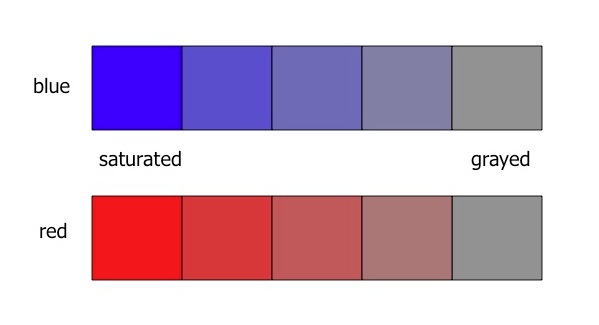
The next attribute of color is chroma. The brightest (highest chroma) any paint will be is when it's straight out of the tube. When it's mixed with any other color, its chroma will decrease. Here is an example of a complete chroma range for blue and red, from the highest chroma all the way to gray:
Colors can be "grayed" by mixing with their complements (colors on the other side of the color wheel) or by mixing with black. Artists have found that the most pleasing grays in their painting are not made from diluting black (or mixing it with white), but by mixing complements.
Hue and chroma can be pictured together using a complex color wheel:
The best way to understand color value is to "squint" so that most of the color we see disappears. Here when we squint and can't see much color, we can see that the blue and yellow scales line up with the gray scale. Also note that although both blue and yellow can be very light, only blue can be really dark. Yellow cannot be made to be dark without changing its color to brown. So yellow has a much smaller "color dynamic range" than blue and most other colors. You just cannot paint a dark yellow! There are many ways to adjust the value of our paint, including mixing it with complements, nearby colors, and black. Often, as we adjust value, we also adjust chroma. The best way to master these changes is to experiment and try them for ourselves, until we understand how we can change each tube color that we use in both chroma and value.
Next time, we'll start our discussion of the principles of design.
If you'd like to have images of my latest paintings, my art activity schedule, and a link to each new artist tip delivered directly to your inbox, sign up for my e-newsletter Here.
Color has three attributes:
- Hue: the name of the color (red, blue, etc.)
- Chroma: the brightness/grayness or purity of the color
- Value: the lightness or darkness of the color
Let's start with hue. The best way to discuss this is to take a look at a typical color wheel:
Warm and cool are attributes that we assign to families of colors, as shown. It's easy to see where the terms come from. Often in painting, it's more important to focus on warm and cool areas than on the particular colors we use.
The next attribute of color is chroma. The brightest (highest chroma) any paint will be is when it's straight out of the tube. When it's mixed with any other color, its chroma will decrease. Here is an example of a complete chroma range for blue and red, from the highest chroma all the way to gray:
Colors can be "grayed" by mixing with their complements (colors on the other side of the color wheel) or by mixing with black. Artists have found that the most pleasing grays in their painting are not made from diluting black (or mixing it with white), but by mixing complements.
Hue and chroma can be pictured together using a complex color wheel:
Here, hue still corresponds to the "clock" position on the wheel, but the colors get grayer as we approach the center of the wheel. If the graphic went all the way to the middle, we would find a gray circle there.
Perhaps the most important attribute to understand, and the one that is hardest to control, is color value. We covered simple value in the previous tip, showing a value scale that went from white to black (a gray scale). But every color also has its own value scale. Here are value scales for blue and yellow, compared to a gray scale:
The best way to understand color value is to "squint" so that most of the color we see disappears. Here when we squint and can't see much color, we can see that the blue and yellow scales line up with the gray scale. Also note that although both blue and yellow can be very light, only blue can be really dark. Yellow cannot be made to be dark without changing its color to brown. So yellow has a much smaller "color dynamic range" than blue and most other colors. You just cannot paint a dark yellow! There are many ways to adjust the value of our paint, including mixing it with complements, nearby colors, and black. Often, as we adjust value, we also adjust chroma. The best way to master these changes is to experiment and try them for ourselves, until we understand how we can change each tube color that we use in both chroma and value.
Next time, we'll start our discussion of the principles of design.
If you'd like to have images of my latest paintings, my art activity schedule, and a link to each new artist tip delivered directly to your inbox, sign up for my e-newsletter Here.
Labels:
artist tips
Tuesday, January 8, 2013
Sleepy Valley - Original Watercolor Painting
On a hazy summer day, cattle graze near the river in this sleepy valley.
If you'd like to purchase this 15" x 22" original watercolor painting for $300 including shipping within the United States, you can do it securely on my website www.jimoberst.com (click on the image). There are additional paintings for sale there, and my smaller paintings are available on my other website www.weeklywatercolor.com. Add a unique original painting to your collection!
Labels:
new paintings
Sunday, January 6, 2013
Artist Tip #9 - Introduction to Design - Elements
Normally, when we begin our artistic journey, we are entirely focused on learning to draw and handle our art materials in order to be able to faithfully represent the scene before us. Typically, our next step is to learn design so we can rearrange and modify what we see in order to make the resulting painting more pleasing to the viewer at the expense of departing a bit from reality. Finally we reach toward developing a purpose, message, or emotion in our artwork. These steps don't follow a strict progression; we continue to develop our skills and methods as we begin to apply design principles to our paintings, and continue both while reaching for meaning and emotion in our artwork.
My first eight artist tips focused on the first stage: convincingly representing reality, and we're not yet done with that. But I'd like to now begin our journey into painting design. Before considering design principles and guidelines, we must first understand what the elements are that we artists have to work with. There's no magic here; we're already familiar with these seven elements of design:
A few words about each will ensure that we are all talking the same language when we get to the actual information on design:
Shapes can be outlined or not, and with straight sides, curved sides, or both. Shapes can be of any size, and can be in any orientation or direction.
Lines can be straight or curved, thick or thin, and of various lengths and directions.
As we can see, size and direction are specific characteristics of shapes and lines. The last 3 elements are also characteristics of shapes and lines, but are worthy of a bit more discussion.
Texture is a characteristic of both the insides and edges of shapes. Three basic textures can be achieved in most painting mediums:
These are illustrated in the following diagram using watercolor on paper:
Value is the lightness or darkness of a shape or line. The easiest way to think of value is as a gray scale:
One use of the gray scale was already covered in Artist Tip #4 - Understanding Cast Shadows (Part 1), where we discussed the value difference between a surface in sunlight and in shadow. However, that was in pursuit of the first stage goal of learning to convincingly represent reality. As a design element, value can be manipulated to improve the impact of our painting at the expense of accurately representing reality.
Color is the last element we have to work with, and it is complex enough to deserve a separate discussion in our next artist tip.
The very best reference I've found on the basics of painting design are several chapters in Tony Couch's classic book, Watercolor You Can Do It. Although it is written from a watercolor perspective, most of its design information is applicable to all mediums. Much of what I have learned about painting design was gleaned from Tony's book and workshops.
My first eight artist tips focused on the first stage: convincingly representing reality, and we're not yet done with that. But I'd like to now begin our journey into painting design. Before considering design principles and guidelines, we must first understand what the elements are that we artists have to work with. There's no magic here; we're already familiar with these seven elements of design:
- Shapes
- Lines
- Size
- Direction
- Texture
- Value
- Color
A few words about each will ensure that we are all talking the same language when we get to the actual information on design:
Shapes can be outlined or not, and with straight sides, curved sides, or both. Shapes can be of any size, and can be in any orientation or direction.
Lines can be straight or curved, thick or thin, and of various lengths and directions.
As we can see, size and direction are specific characteristics of shapes and lines. The last 3 elements are also characteristics of shapes and lines, but are worthy of a bit more discussion.
Texture is a characteristic of both the insides and edges of shapes. Three basic textures can be achieved in most painting mediums:
- Hard or smooth
- Rough
- Soft
These are illustrated in the following diagram using watercolor on paper:
Value is the lightness or darkness of a shape or line. The easiest way to think of value is as a gray scale:
One use of the gray scale was already covered in Artist Tip #4 - Understanding Cast Shadows (Part 1), where we discussed the value difference between a surface in sunlight and in shadow. However, that was in pursuit of the first stage goal of learning to convincingly represent reality. As a design element, value can be manipulated to improve the impact of our painting at the expense of accurately representing reality.
Color is the last element we have to work with, and it is complex enough to deserve a separate discussion in our next artist tip.
The very best reference I've found on the basics of painting design are several chapters in Tony Couch's classic book, Watercolor You Can Do It. Although it is written from a watercolor perspective, most of its design information is applicable to all mediums. Much of what I have learned about painting design was gleaned from Tony's book and workshops.
Labels:
artist tips
Sunday, December 30, 2012
Early Evening - Original Watercolor Painting
The sky glows and the shadows lengthen as the sun goes down, giving this farmland a magical feeling.
If you'd like to purchase this 11" x 15" original watercolor painting for $200 including shipping within the United States, you can do it securely on my website www.jimoberst.com (click on the image). There are additional paintings for sale there, and my smaller paintings are available on my other website www.weeklywatercolor.com. Add a unique original painting to your collection!
Labels:
new paintings
Friday, December 14, 2012
Artist Tip #8 - Heaven and Earth First
I'd like to talk about one way to make painting - and especially watercolor painting - easier and more enjoyable. Paint all of the sky and the ground or water first whenever possible! Then tackle the remaining content of the painting. This is very simple to do in opaque media like oil, acrylic, and pastel, but it's also possible in transparent watercolor most of the time. I've been doing this for a long time, and recently I've heard Joseph Zbukvic call this "painting heaven and earth first", and I really like his phraseology.
Since watercolor is transparent, it's impossible to paint a light passage on top of a dark one - the dark color just shows through. Therefore watercolor painters get a lot of practice painting around shapes that will have a light value (called "saving the whites"). Saving the whites can also be done with masking fluid or masking film as an extra, preliminary step. But the easiest thing to do is to plan your painting to minimize the need to paint around shapes, or to make these white shapes as few and simple as possible. I'll show what I mean with a few step-by-step examples.
The absolutely simplest situation is where everything that is layered "on top of" the sky and water or ground will be a significantly darker value. In this situation, the entire paper can be first covered with sky and earth, and then the rest of the painting just painted on top of it. Storm Approaching is an example of this sort of painting:
Since watercolor is transparent, it's impossible to paint a light passage on top of a dark one - the dark color just shows through. Therefore watercolor painters get a lot of practice painting around shapes that will have a light value (called "saving the whites"). Saving the whites can also be done with masking fluid or masking film as an extra, preliminary step. But the easiest thing to do is to plan your painting to minimize the need to paint around shapes, or to make these white shapes as few and simple as possible. I'll show what I mean with a few step-by-step examples.
The absolutely simplest situation is where everything that is layered "on top of" the sky and water or ground will be a significantly darker value. In this situation, the entire paper can be first covered with sky and earth, and then the rest of the painting just painted on top of it. Storm Approaching is an example of this sort of painting:
The sky and water were first painted over the entire sheet. Then all of the other shapes were added on top, and are dark enough that the sky and water do not show through.
The next example, Off Prince Edward Island, is similar, except that there is a single small white shape saved for the boat hull and white water near the hull. After the sky and water are painted, everything else is dark enough to be painted on top of the background. First the large sail and land shapes are painted, and then the small details:
My final example is a painting of an old barn, titled Abandoned. In this painting, the sky and ground are first painted, without worrying about the foliage, which will easily cover the sky. However, the barn itself is "painted around", leaving white paper there. Next, the foliage is added. Finally, the barn and other details are painted:
The bottom line of this post is that when possible, paint "heaven and earth" first, only saving whites where a lighter value will need to be used. Then proceed to smaller and smaller details. Particularly in a transparent medium like watercolor, it is critical to plan the steps of your painting, so you can work from light to dark and thus minimize the negative painting required. In opaque mediums, this is not as important, but it's still a good idea to approach paintings in some sort of "regular" way, working from large shapes to small - and in a landscape, "heaven and earth" are usually the largest shapes.
Labels:
artist tips
Thursday, December 6, 2012
Meager Pickings - Original Watercolor Painting
This little farmyard has seen better days.
If you'd like to purchase this 7.5" x 22" original watercolor painting for $225 including shipping within the United States, you can do it securely on my website www.jimoberst.com. There are additional paintings for sale there, and my smaller paintings are available on my other website www.weeklywatercolor.com. Add a unique original painting to your collection!
Labels:
new paintings
Friday, November 30, 2012
Artist Tip #7 - Painting Reflections
We artists often want to add reflections off water or hard, shiny surfaces. First, some general advice:
- Reflections always come vertically to the bottom of the picture plane, never at an angle. This is a very basic difference between reflections and shadows.
- Reflections can be the same or a different value or color as the object being reflected. If the reflection is an exact inverted copy of the object, the painting can be confusing, so it's best to adjust some element of the reflection to be different.
- Reflections, like shadows, look better if they don't perfectly imitate the shape of the object being reflected.
- Reflections usually have a different view of the reflecting object than the direct view of that object. Because the light from the object goes down to the reflecting surface and then bounces back up to the viewer's eye, reflections show more of the underside of the object than the direct view does.
- It's wise to wait until the object itself is painted before painting its reflection, because some objects change as the painting progresses, and the reflection depends upon the object.
Let's first discuss reflections off water. If the water is rough, the viewer tends to see little reflection of objects, but mostly reflections of the sky or simply a view through the water itself. So in rough water, don't paint reflections of objects, or at the most, only hint at them, as in this painting, Morning in Maine.
For fairly smooth water, reflections are usually called for. There are two basic and very different approaches, and the artist needs to decide which is most appropriate for the painting. The first is a soft, diffuse reflection, normally painted with vertical strokes under the reflecting object. In watercolor, the already-painted water can be rewet (after it is very dry!) and the vertical reflection paint strokes will diffuse, giving a soft reflection. This technique is shown in this painting, Quiet Evening:
The second approach to water reflections is to paint hard-edge reflections, which loosely mimic the reflecting object but with some ripples to make the reflection shape interesting. This technique is shown in this painting, The Red Dinghy:
When adding reflections to a shiny, hard surface, I generally find that a third approach sometimes gives interesting and convincing results. This is to paint the reflection in rough, vertical strokes, leaving some untouched paper to give the reflection "sparkle". In addition, when painting reflections on a hard surface, it's important to put some other marks on the surface - for example, lines representing cracks or seams - so it reads as a horizontal surface and not as a vertical surface or as water. This painting, Fruit, is an example of this approach:
One final suggestion: when painting any object sitting on a reflecting surface, it is important to paint a very narrow "crevice dark" along the bottom of the object. If this isn't done, one can give the impression that the object - boat, fruit, person - is floating above the surface. You can see a crevice dark in all of the example paintings in this post.
Labels:
artist tips
Thursday, November 22, 2012
Fruit - Original Watercolor Painting
I often use this very colorful still life as the basis for a paint-along in my watercolor workshops, to get students comfortable with painting shapes with hard and soft edges, making soft backgrounds, trying the dry brush approach, and making marks with spatter and lines.
If you'd like to purchase this 11" x 15" original watercolor painting for $200 including shipping within the United States, you can do it securely on my website www.jimoberst.com. There are additional paintings for sale there, and my smaller paintings are available on my other website www.weeklywatercolor.com. Add a unique original painting to your collection!
Labels:
new paintings
Wednesday, November 14, 2012
Artist Tip #6 - Understanding Cast Shadows (Part 3)
Our last tip addressed the direction of cast shadows in backlit scenes. In this final tip, I'll discuss a few more details that will help your cast shadows make your paintings more pleasing.
I suggest you do not paint cast shadows separately, but paint them right over the already-painted object they are falling on. With watercolor, this has to be done after the base color is bone-dry, or a muddy mess will be the result.
Let's consider shadow color. Shadows can and do have color, and we can make our paintings more entertaining by emphasizing or exaggerating their color. I haven't found a color formula for shadows that always works, but you can consider the following possibile approaches.
- For outdoor scenes, shadows often tend towards blue or purple due to the cool nature of the light from the sky.
- A different approach involves painting over the base color with its complement. For example, on a yellow object, a purple hue often works very well to represent a cast shadow.
- Finally, cast shadows can be livened up by painting the basic shadow and then charging in other colors. For an impressionistic-style painting, it's not really necessary to "explain" where these charged colors come from, but claiming "color bounce" from nearby objects is a great excuse if you feel you need one.
Actual cast shadows are harder-edge near the object casting the shadow, and become softer-edged as the distance from the object increases. Leaving a few soft or rough edges on cast shadows makes them look more like shadows and less like dark shapes cut out and glued down. Of course, this is true for all shapes in our paintings - we need to vary the edges to integrate them into the painting.
I've found that when shadows fall mainly side-to-side in my paintings, they look best when all painted in roughly the same direction. They also look better if their shape doesn't exactly match the shape of the object casting the shadow, but simply suggests that shape. Care should be taken to connect shadows to the objects that cast them, so they "belong" to one another without an obvious change in color or value. When figures cast shadows on the ground, these shadows "anchor" the figures in place and help to make them more realistic.
Finally, often a shadow is needed in a painting for design or composition reasons. For example, many paintings can be improved by adding a dark shadow in the foreground, at the bottom of the painting. This sort of shadow helps to lead the viewer's eye over the foreground and into the painting. Such shadows can be added when needed without having to explain what object outside the picture plane is causing them. I've included a painting with such a "dark doorstep" to illustrate this design technique.
If you'd like to review previous artist tips, you can find them all by going to the search box in the right-hand column of this blog, and searching for artist tips.
Labels:
artist tips
Monday, November 5, 2012
Port Penrhyn, Wales - Original Watercolor Painting
Port Penrhyn, Wales, just outside of Bangor, was built around 1800 to enable exporting slate from Penrhyn quarry. It's now a normal boatyard and docking facility. This view is at low tide, when many of the boats in the harbor stand out of the water - the sailboats on their double keels so they don't fall over.
If you'd like to purchase this 11" x 15" original watercolor painting for $200 including shipping within the United States, you can do it securely on my website www.jimoberst.com. There are additional paintings for sale there, and my smaller paintings are available on my other website www.weeklywatercolor.com. Add a unique original painting to your collection!
Labels:
new paintings
Thursday, November 1, 2012
Artist Tip #5 - Understanding Cast Shadows (Part 2)
Our last tip addressed the value (the relative darkness) of cast shadows. This tip will focus on the direction of cast shadows in front- and back-lit scenes. I'll specifically discuss shadows in sunny and moon-lit landscapes, but the same considerations apply for other light sources like lamps, and even multiple cast shadows caused by multiple light sources.
When painting a well-lit scene, we need not understand the theory of shadows. We can simply paint the shadows as we see them. It is when we are "adding" sunlight or moonlight to an overcast scene, rearranging the objects, or painting an entirely contrived scene, that we need to understand the theory of shadow directions so that our finished painting looks believable.
Let's first consider a sunny landscape with the sun above the top of our picture plane and behind the objects being painted, so that they are "backlighted". Since the sunbeams travel in a straight line, any shadows cast by objects or people must lie along the line between the object and the sun. This can be seen in the accompanying painting, appropriately named Shadows.
Here, the sun is positioned above the largest figure's head just above the top of the paper, and behind all of the objects in the painting. You can see that the shadows approximately lie along a line drawn between the objects (the figures, or the boats) and the sun position. But we have all heard that the sun is so far away that all its light beams are parallel, so... why are the shadows in this painting not parallel to one another?
The answer is that they are parallel. Recall that in perspective, parallel lines converge to a vanishing point - in this case, the sun. So it's a mistake to paint in the same direction all shadows that mainly come either forward or backward. They need to be painted toward a vanishing point (roughly, not necessarily exactly). This fact about shadows in paintings is not intuitive, so you may need to think about it, and even draw some lines up into your "sky", to fully make this fact your own.
I thought that two Artist Tips would take care of cast shadows, but I still have a little more to say about them. Stay tuned for Part 3 in Artist Tip #6.
When painting a well-lit scene, we need not understand the theory of shadows. We can simply paint the shadows as we see them. It is when we are "adding" sunlight or moonlight to an overcast scene, rearranging the objects, or painting an entirely contrived scene, that we need to understand the theory of shadow directions so that our finished painting looks believable.
Let's first consider a sunny landscape with the sun above the top of our picture plane and behind the objects being painted, so that they are "backlighted". Since the sunbeams travel in a straight line, any shadows cast by objects or people must lie along the line between the object and the sun. This can be seen in the accompanying painting, appropriately named Shadows.
Here, the sun is positioned above the largest figure's head just above the top of the paper, and behind all of the objects in the painting. You can see that the shadows approximately lie along a line drawn between the objects (the figures, or the boats) and the sun position. But we have all heard that the sun is so far away that all its light beams are parallel, so... why are the shadows in this painting not parallel to one another?
The answer is that they are parallel. Recall that in perspective, parallel lines converge to a vanishing point - in this case, the sun. So it's a mistake to paint in the same direction all shadows that mainly come either forward or backward. They need to be painted toward a vanishing point (roughly, not necessarily exactly). This fact about shadows in paintings is not intuitive, so you may need to think about it, and even draw some lines up into your "sky", to fully make this fact your own.
I thought that two Artist Tips would take care of cast shadows, but I still have a little more to say about them. Stay tuned for Part 3 in Artist Tip #6.
Labels:
artist tips
Subscribe to:
Posts (Atom)